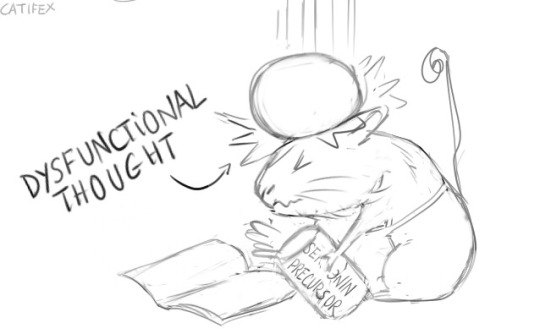
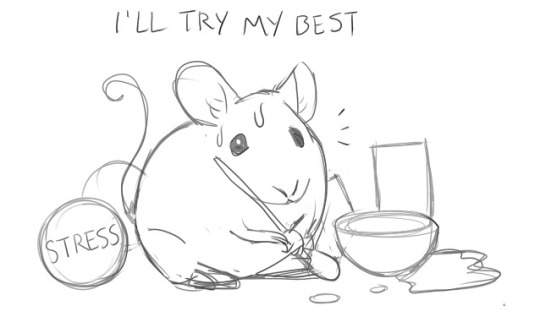
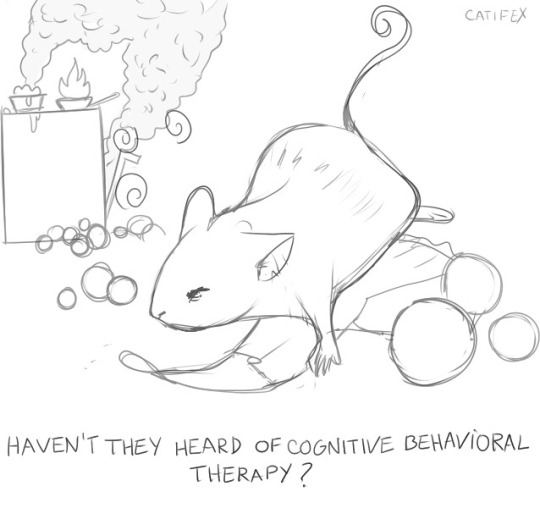
if i knew how to control hyperfocus i’d get a lot more writing done
(almost every time that i have been notably productive, posting a lot of fic, etc, i was in a near-constant state of hyperfocus in ways that were probably detrimental to my overall health whoops)
if you can brute force your way into starting something you’ll probably end up stuck doing it just out of inertia but figuring out the best way to force the issue is hard
I think this sort of thing works differently for everyone, but I’ve slowly been getting better at managing hyperfocus, so here’s some notes on what works for me.
[For these examples, homework is generally the thing I want to be able to hyperfocus on, while art / reading / tumblr are things I find it easy to hyperfocus on. Which things are which varies person to person!]
– I’m aiming for management, not control. I’ve found that trying to force my mental state to be in a certain mode at a certain time is very stressful, exhausting, and if it works at all the state I end up with is a sort of spiteful dissociative emotional-flatline hyperfocus. It’s not good for me in the long term, and while it can be useful for pushing through homework, it’s pretty much incompatible with doing things that involve inspiration and joy, like art.
– So instead, I’m working on identifying different states of focus or functionality that my brain inhabits, and understanding when and why they tend to happen. I’ve found that there’s a variety of factors that make certain states more or less likely, like what physical space I’m in, and how much sleep I’ve had, and whether other people are around. These factors are things I can control, so I try to modify them to coax my brain into a focus state I want, rather than trying to change my mental state directly. Some things to consider are: what kind of background noise do you find soothing? energizing? stressful? overwhelming? Would having a friend nearby help keep you engaged in what you’re doing, or would it distract you? Is there a space in your life that you can designate to only spend time in when you’re focusing, and leave as soon as you get distracted? (This can help cue your brain to focus as soon as you arrive in the space.) Likewise, is there a space you can designate for relaxation? What effect does caffeine have on you specifically? (This one varies a TON for people with ADHD. I’d say it’s at least worth experimenting with, and recommend trying low doses like tea or chocolate for less jarring effects.)
– That being said, it’s at least as important to listen to the state you’re in as to try to change it. I’m finding that some mental states are a sort of early warning or a request for self care, and if I listen to what they want from me, I can avoid getting into the really bad states. For example, sometimes I’ll get out of class on a sunny afternoon feeling pretty good, like I probably have enough energy to do homework – but what I really want to do is sit in the sun and draw. My brain is presenting me with an offer to focus on art, to really get into it – that’s the focus state it wants to be in. I can still chose to ignore it and go do homework, and I’ll probably be able to get some work done, but it’ll take more time and energy to focus than usual, and leave me pretty exhausted. Whereas if I take the offer to sit and draw, I’ll not only get a lot out of my engagement with my art, I’ll also feel satisfied and refreshed. Because I’m not fighting my brain on what it wants. Deadlines and schedules being what they are, I can’t always take that option. But the more often I’m able to indulge my brain in the ways it wants to focus, the better my mental health stays, and the more likely I am to end up in mental states that are ideal for doing homework.
– Identify the ideal mental state for doing a certain task, and the not-ideal-but-good-enough mental states, and the not-even-even-worth-trying mental states. I have a state where I feel full of energy and determination, and I want to do something that challenges me, or something that gives me satisfaction – that’s the ideal state for homework or housecleaning. I have a state where I feel full of energy and inspiration, I want to express myself, to engage with something, to make something – that’s the ideal state for doing art. They might seem pretty similar at first glance, but trying to do homework in the inspired state fucking sucks. It’s pretty possible to do art in the determination state, but usually I grab the opportunity to get homework or cleaning done. I have a state where I feel pretty neutral, focused but not hyperfocused, so I kind of bounce from task to task. As long as I don’t choose any tasks I’m likely to get hyperfocused on, I can juggle getting a couple things done gradually. Maybe bouncing between math problems and loading the dishwasher. I have a state where I feel emotionally ok, but like I just can’t focus on anything, and I need to curl up and indulge in something soothing and distracting. This is very much a warning sort of state. If I try to push myself into focusing and functioning in that state, I’ll be miserable, anxious, and get basically nothing done, as well as kicking my emotional state into something I need to spend time recovering from – further sabotaging my ability to get anything done for the next few days. If I just give up that homework assignment as a lost cause and take care of myself, my mental state will actively improve, and I’ll be more able to focus the next day.
– There are also the Bad States, where I may or may not be able to focus but I feel like shit. The whole point of this management strategy is to avoid those as much as possible. Even if I can focus in “I hate everything including myself and I’m going to fucking fight it” state, it’s not worth it in the long run.
So here’s a rough layout of my strategy for applying these concepts:
– I keep a running list of things to do. It contains things that need doing (housecleaning, homework assignments due soon), things I want to get done (art projects I’m working on, reorganizing my room), and things that will make me feel good to do (seeing friends, mucking around with art in an unfocused way, researching special interests). – When I have some piece of time – say I’ve just gotten out of class for the day – I take stock of my mental state. What kinds of tasks would I be up for doing? Is there something I’m feeling especially drawn to do? – If I’m feeling like I’m in a good state for functioning in a particular way, and there’s something on my list that suits that, great! That’s my plan now. – If I’m feeling like I’m in a kind of mediocre function state, I consider what things I could do to modify it. Would it help to go somewhere with a focused atmosphere and a background level of light and noise that takes up some sensory processing but not too much? Would it help to go somewhere very quiet or isolated with no distracting noise or movement? Would it help to get a meal, or a cup of coffee? Would it help to take some time to relax first and do something from the feel good list, and check back in later? – If possible, I chose a way to try to improve my function state. Or, if nothing seems super promising for helping, I go through my list for a task I could probably get done at my function level, like a small assignment. Sometimes, starting out by focusing on a small assignment helps get my brain in gear to focus on something harder. Also, doing something satisfying (like completing a drawing, or finishing a cleaning task) can sometimes help me feel more functional, and springboard up into a better level of focus. And if not, hey, at least I got that one thing done! – If I’m feeling like shit, I start by troubleshooting. Am I hungry? Dehydrated? Overstimulated? In pain? First thing first, fix that problem. Then choose a feel good task. Best case scenario, I’ll feel better in a bit and loop back to the top of this list and try again. But if not, I’ll take care of myself and try again tomorrow.
Miscellaneous other notes:
– Transitional tasks! Small, well-defined tasks with a clear finishing point can be useful for working up into a focused state. It’s important to chose tasks for this that won’t get you drawn in to doing something that’s not what you’re trying to work up to – which is why you need to make sure there’s a fixed endpoint past which you can’t really keep working. The smaller and faster the task is, the better. What you’re going for is the little rush of confidence and satisfaction that happens when you finish something – so you can use that energy boost to start something bigger. You can chain these together, too, starting super small and working up to bigger things. Or you can take a break from an exhausting project to do a small thing start to finish for that satisfaction boost.
– Stimmmmmm. For a good focus state, you need enough of your brain occupied that you don’t get distracted, but not so much going on that you get overstimulated. Stim toys and body motion stimming are great, but I personally find them hard to balance with working on something steadily? I actually just… forget to stim. So I rely a lot on managing how stimulating my environment is. That includes background noise (both volume and how chaotic it is), visual input (whether there’s a lot of motions, colors, variations in the lighting, etc) and how many people are present (passively keeping track of what people are doing around me is a mental process separate from just how much noise they’re making.) I’m also personally pretty sensitive to the mood of a crowd, so it can be helpful to work near other people who are clearly focused, and hard to work near people being social. Art wise, a group of people who are all doing art can be really energizing and inspiring – but it can also be really overwhelming. Especially because some people do art in a very laid-back way, and some people do art in a very intense way, and these can conflict. I’d say groups of two or three people who do art with a similar energy level are ideal.
– Refocusing. When I’m working along on something and feel myself starting to get frazzled, I get up and get myself a glass of cold water. The goal is to disengage with the task, give my brain a minute to shake itself out, and then sit right back down and re-engage. Physical motion helps, it gets the restless feeling out. Taking a drink of cold water is calming, just enough sensation to momentarily pull in your attention. Also, it helps you stay hydrated!
– Keep yourself fed and watered! It can be really hard to remember to eat in hyperfocus. This is extra unfortunate, because focusing takes a huge amount of energy. Your brain physically needs energy to function, and it gets that energy in the form of sugar. Thinking hard burns through an incredible amount of sugar. If you start to feel wrung out, try getting some quick sugar into yourself – fruit juice, soda, ice cream, a chocolate bar. It’s amazing how much it makes you feel like you can think again. Obviously, also eat actual nutritious meals, your body needs more than sugar to survive! But making sure to keep your brain supplied with sugar can really help with focusing for long periods of time, and not feeling like a monster afterwords. Also drink plenty of water, or you might emerge from hyperfocus with a nasty headache.
That’s about all I’ve got! Sorry this is so dang long, but hopefully something in there is at least a little useful.
“If a person can’t get out of bed, something is making them exhausted. If a student isn’t writing papers, there’s some aspect of the assignment that they can’t do without help. If an employee misses deadlines constantly, something is making organization and deadline-meeting difficult. Even if a person is actively choosing to self-sabotage, there’s a reason for it — some fear they’re working through, some need not being met, a lack of self-esteem being expressed. People do not choose to fail or disappoint. No one wants to feel incapable, apathetic, or ineffective. If you look at a person’s action (or inaction) and see only laziness, you are missing key details. There is always an explanation. There are always barriers. Just because you can’t see them, or don’t view them as legitimate, doesn’t mean they’re not there. Look harder. Maybe you weren’t always able to look at human behavior this way. That’s okay. Now you are. Give it a try.”
(And a footnote I didn’t see explicitly covered in the article: laziness still doesn’t exist when it is you yourself making no progress and not knowing why. You deserve that respect and consideration, too, even from yourself.)
so in my session today I was talking abt how I tend to just be super hard on myself abt everything all the time forever, like ya do, and how deeply ineffective this attitude is as a general guiding philosophy, and my counsellor said “what if you just… PRETENDED you were worthy of compassion? like, what do you think would happen?” and I was forced to conclude that YEAH, that’s probably SOMEWHAT REASONABLE, I probably won’t LITERALLY DIE if I try this for five minutes?? and she literally told me to write it down and keep it somewhere I’ll definitely see it (i.e., how I ensure that anything else I need to do for any reason ever gets done) so
therapy really is just someone gently giving you the most basic instructions for how to be a human person, and then reminding you every few weeks when you come back having inevitably forgotten them, in perpetuity
A lot of the advice I got about learning to enforce my boundaries was framed as an adversarial thing. Like, ‘yes, it might upset and disappoint the people around you, but you have to learn to tell them ‘no’ anyway.’ At best, ‘good people will still like you if you enforce your boundaries’.
What I wish I’d been told is that good people will think it’s awesome that you enforce your boundaries, that there are people who will respect the hell out of you for it, that there are people who will admire you not despite you telling them no, but because of it. That most people don’t want to make you do something you don’t enjoy,and so they’ll actively be happier and more relaxed around you if they know they can trust you to decline to do things you don’t enjoy and to ask them to stop things that bother you.
It helped me a lot, personally, to stop thinking of ‘enforcing my boundaries’ as something I did for me and more as something I did to empower the people I was close with, to build a situation where they and I felt sure everything that was going on was something we all wanted.
Most advice isn’t good for everyone and this advice seems maybe bad for people in abusive situations, because sometimes you do need to learn to enforce boundaries against people who will try to violate them. But if there are other brains like me out there: your partner will be really happy you can say no to them. your friend will be really happy you change the subject when you hate it. your roommate will really appreciate that you tell them to turn down the music. most people will feel safer and more comfortable around you if they know you’ll reliably express your needs, AND they’ll feel better about voicing theirs.
One last hot take and then I’ll shut up: the reason adhd is framed first and foremost as a learning disability when it is in fact more apt to call it an emotional processing disorder is bc our society is only concerned w the ways neurological disorders impede a person’s ability to “function” aka get a job and contribute positively to capitalist society. How adhd affects interpersonal behaviors and emotional health is only relevant insofar as it relates to a person’s level of societal functioning PERIOD. There is no interest in improving our actual livelihoods
This is why girls are often not diagnosed w adhd until they are much older, bc they are forced to develop certain social awareness and self-surveillance capacities at an extremely young age and thus don’t perform “poorly” in the areas usually looked at to signify the disorder. But that doesn’t mean girls don’t take that distress out thru other avenues, just that the many alternative iterations of the disorder are ignored by professionals bc they don’t matter as far as society is concerned, as long as a girl is performing “well enough”
this is so real & it’s honestly something that took me until AFTER I got diagnosed and on meds to figure out. at first I was amazed that many of my academic/work-related ‘bad habits’ had not gone away, but after a year on meds I’ve seen a HUGE change in how I process emotions and navigate interpersonal relationships, so much so that I honestly have no idea how I coped pre-diagnosis. the truth is that work habits are habits, and are hard to shake, and take an effort beyond what medication can provide to overcome! if anything, the thing that changed was how I saw my relationship to my sense of self relative to my work (no longer internalized it as “inherent” to me, etc.) sorry to jump on this post but talking about ADHD as an emotional disorder truly does resonate with me!
LET’S GET THIS SHIT GOING, OK? PLEASE EXCUSE THE SWEARING I CANNOT HELP MYSELF.
*rolls up sleeves*
1) I can’t live in the moment because I am too busy trying to keep my impulses under control. 2) I am not energetic – I am exhausted from trying to bottle up energy so I don’t lose my goddamn mind. 3) I am not in a state of relaxation – I am overwhelmed by the inability to filter stimuli so that I can focus on anything that “matters” and so I have retreated into my own goddamn head. 4) I notice *everything* because I literally cannot and I literally have no idea which parts are supposed to be fucking important. 5) I’m not fucking free of endless lists of things to do – I have at least twice as many lists as you do so that I can fucking remember anything. 6) I am not “unbound” by material things – I am a fucking trainwreck when my routine isn’t followed to the fucking letter and otherwise will spend an hour looking for keys. 7) I am not tuning out “annoying” stimuli – I am often tuning out important things, I am focusing on things I shouldn’t and I can’t stop. 8) I am not merely “passionate” – I am a fucking fire hose with no fucking off switch – Good luck ever getting me off a subject if I find one I like. 9) See 8. 10) No guilt over mistakes? What the actual fuck does that even mean? Do you know how hard it is to ram your head into an idea over and over and fucking over until you are having a meltdown because you are stupid? 11) Capacity for play until you decide that playtime’s over and it’s time to move on – no, it’s not, not yet, and I have so much more work to do with this thing you were doing. 12) FUCK if I could just be fucking NORMAL for a day, I would cry tears of joy. 13) See 8. And 9. 14) Singlemindedness seems fine until you can’t decide what to eat or even remember to eat because you are ear-deep in the project you were forcibly torn away from. 15) Unique sense of humor – sure, they’re laughing with you until you grow up and realize they’re laughing AT you but you just can’t fucking shut up now. 16) I get my own needs met – sure, by taking attention from others. 17) Desires for more – so… greedy motherfucker, just fucking say it. 18) See 17. 19) Free from self-consciousness? Do you have any idea how many hours of my life I have lost because I am freaking out because of this thing I LITERALLY CANNOT FUCKING CONTROL? 20) SEE FUCKING NUMBER 19. I FUCKING CANNOT CONTROL THIS. 21) You know I just can’t fucking even with this list. Fuck everything.
Hey look, it’s ableism masquerading as positivity! The kind of crap in this list of “superpowers” may look nicer than someone talking about how ADHD is “overdiagnosed” or “fake” because kids today don’t eat enough dirt and play in traffic Like The Good Old Days, but underneath it’s the same old "if you just tried hard enough” thinking. Here’s the thing; with diagnoses involving executive function, there is no “just” try hard enough. That is LITERALLY the problem. Everything is a big deal (or nothing at all is because how do you decide?). Everything takes as much effort whether it’s picking up the laundry or composing a symphony, because nothing logically leads to the next step. Nothing is proportionate or prioritizable without a lot of fucking work that NT brains do on autopilot. This is like the BS about Depression making Beautiful Art and Insight – no, it does not. ADHD is not a superpower just like suffering is not genius. And the people who have both need support, not patronizing assurances that they too can be inspiration porn if they just want to badly enough.
lmao I love how it’s not even like “here are some ways u might be framing this negatively” like nah you’re straight up just selfish and greedy
Your negative feelings are valid, because all feelings are valid, but they can distort your beliefs and behavior when you don’t give enough consideration to alternatives.
When you think I bet nobody really likes me, they’re probably just tolerating me to be polite, also ask How can I let the people around me know that I genuinely like them?
When you think I’m so lazy and unproductive, also ask What’s one small but useful thing I can get done in the next hour?
When you think The FBI agent assigned to me must think I’m such a loser, also ask How can I radicalize my FBI agent?
This is the kind of mental health advice we can all use.
a lot of writing advice starts with something like REMOVE ALL DISTRACTIONS, which is to say, cultivate an environment in which you are comfortable and take out/cut down on the stuff that will tempt you to procrastinate or give you an excuse (an excuse, not a reason) to do Like, Literally Anything Else. this is broad but not necessarily bad advice ime! I have a desk. I can usually do what I need to do to put myself in the Okay, Self, It Is Time To Write mindset and usually get some bigger distractions out of the way. the problem with my dumb ADHD ass, as you probably already know, is that EVERYTHING IS DISTRACTING ALL OF THE TIME. life is distraction, highness, and anyone who says differently is selling something. like, right now? I wanna write, but I need to eat and return an email and several texts in a somewhat timely manner and put clean sheets back on my bed and check the mail and trim my bangs and finish a cross stitch to mail to a friend and like eight hundred other tiny things that I literally cannot filter out. I can prioritize some of it, but if I just… do things as it occurs to me to do them I’ll never get around to writing, and if I put them aside For Now I will forget or be plagued by them and STILL won’t write. tl;dr: I am constitutionally incapable of prioritizing or managing time and things??? never stop happening??? there are always things??? help
cleaning with ADHD is a nightmare. it’s an endless cycle of finding a half-finished chore and stopping the one you were already working on, then remembering that something else needs to be done and getting started on that, then finding half-finished chore and
i have the solution! i call it ‘junebugging’.
have you ever seen a junebug get to grips with a window screen? it’s remarkably persistent, but not very focused. all that matters is location.
how to junebug: choose the location you feel you can probably get some shit done on today. be specific. not ‘the bathroom’ but ‘the bathroom sink’. you are not choosing a range, you are choosing a center; you will move around, but your location is where you’ll keep coming back to. mentally stick a pin in it. consider yourself tethered to that spot by a long mental bungee cord.
go to your location. look at stuff. move stuff around. do a thing. get distracted. remember you’re junebugging the bathroom sink and go back there. look at it some more. do a different thing. get distracted. get a sandwich. remember you’re junebugging and go back to the bathroom sink.
nt’s will go crazy watching you, and if they demand to know When You Will Be Done you will probably have to roll them in a carpet and stuff them up the chimney. you’re done when you feel done, or you’re too bored to live, or it’s bedtime, or any number of other markers, you get to pick. but the thing is, by returning repeatedly to that one spot, you harness the ‘hyperactivity’ part instead of wasting all that energy battling with the ‘attention deficit’ part.
not only will the bathroom sink almost certainly be clean, and probably the mirror and soap dish too, you might’ve swapped in a fresh toothbrush, a new soap, you might’ve unclogged the drain – you will probably also have cleaned or fixed up several things in the near vicinity, or in the path between the sink and where you get the fresh toothbrush, or maybe you did your grocery shopping cuz you were out of soap, or maybe you couldn’t find a clean hand towel and ended up doing laundry.
this is good. you got shit done! it wasn’t necessarily Cleaned The Bathroom in the way nt’s think of it, but screw ‘em. things are better than they were.
plus you worked off enough energy to be able to sleep. which is not small potatoes when living the ADHD life. 😀
Don’t let the adorable name fool you—this is some Seriously Good Advice. May be useful for brain fog and depression, too!