While cleaning out my room I found a paper that my therapist gave me some time ago to deal with obsessive and intrusive thoughts. Sorry the paper is a little crinkled and stained, but I figured I’d post it in hopes that it will help someone like it helped me.
Here it is again with text for anyone who can’t see the picture
That thought isn’t helpful right now.
Now is not the time to think about it. I can think about it later.
This is irrational. I’m going to let it go.
I won’t argue with an irrational thought.
This is not an emergency. I can slow down and think clearly about what I need.
This feels threatening and urgent, but it really isn’t.
I don’t have to be perfect to be OK.
I don’t have to figure out this question. The best thing to do is just drop it.
It’s OK to make mistakes.
I already know from my past experiences that these fears are irrational.
I have to take risks in order to be free. I’m willing to take this risk.
It’s OK that I just had that thought/image, and it doesn’t mean anything. I don’t have to pay attention to it.
I’m ready to move on now.
I can handle being wrong.
I don’t have to suffer like this. I deserve to feel comfortable.
That’s not my responsibility.
That’s not my problem.
I’ve done the best I can.
It’s good practice to let go of this worry. I want to practice.
Im in a therapy program right now and this is literally half of what they teach us, so please y’all give this a go
executive dysfunction is telling yourself for two and a half hours that you need to shower bc you smell like your workplace and you absolutely Cannot do Anything Else until you shower, doing Any Other Thing before showering is illegal!!! but you still haven’t for some reason??? you’ve just been sitting on your bed in a towel scrolling tumblr for 2+ hours thinking “I need to shower right now immediately” and growing increasingly frustrated that you are still not clean and you haven’t eaten or done your laundry either
ok actually no I’m reblogging this because a) I am clean now (and I smell amazing, thank you), and b) I had a heckin Realize and I wanted to share it with y’all in the hopes it’ll help someone else with a brain like mine.
I figured something out about myself a long time ago– it’s only just now occurred to me that I was in fact solving a problem caused by executive dysfunction, and I haven’t been implementing this solution lately because my brain went “that’s a relatively new term to me and therefore a Different problem that requires a Different solution”. thanks a lot, brain.
anyway, long long ago, before I knew these fancy schmancy Official words, the problem, as I phrased it to myself, was such:
sometimes I get Stuck. I was doing something, or on my way to doing something, and then… I just. got stuck.
“Stuck” looks like refreshing my feed or dashboard repeatedly. or it looks like staring at a spot on the wall. or chewing my fingernails. or picking at a stubborn sticker. all the while, my brain drifts through various unrelated topics I wouldn’t be able to recall if asked. sometimes I can get Stuck for hours before realizing I am Stuck. sometimes I get so Stuck that I go to bed that way (feeling especially bad for being unproductive) and I have to just reset everything by sleeping.
one day I asked myself, “why is this happening? why am I stuck, right now, at this moment in time?” the answer, as it turns out, was pretty simple: I was trying to make a decision, and I got distracted. I haven’t moved forward because I haven’t answered that one question or made up my mind.
let me rephrase this in terms of executive dysfunction: many people have expressed that it feels like knowing you need to do a thing but not feeling “ready” to do it. many with ADHD may also be familiar with the feeling of needing things to be “just so” before you embark on a task- you need your setup to look a certain way, or you need to set a timer, or have the right music playing, etc.
when I get Stuck it’s often because I got lost somewhere in that setting-up process, and my brain took the opportunity to nyoom off into Distraction Town.
getting myself Unstuck is solved, 95% of the time, by tracing my steps back to the original decision I was trying to make- often something small and inane- and then troubleshooting from there. (out loud! verbal processing is totally punk.)
“what was I trying to do?”
“was I trying to decide between two things?”
(the answer’s usually yes.)
“what were they?”
“okay, let’s decide.
“okay, that’s settled. let’s move on.”
and then I am free as a bird to nyoom in the direction of The Thing I Wanted To Do All Along, in the amazingly disorganized, scattered, yet rapid-fire way that I do many things.
so!!! in the case of my first post, where I hadn’t showered for 2 hours? turns out I had been trying to decide what music to listen to in the shower. (another hack: my chances of getting Stuck while showering decrease by 75% if I have music playing to help me keep track of time.) I couldn’t immediately make up my mind, got lost in thought, got distracted, and drifted. once I stopped and asked- “why am I stuck?”- then I remembered- “oh yeah! I wanted to listen to music”- and then decided- “I want to listen to Daft Punk’s Discovery album”- I was finally heckin able to shower. and also eat, and also throw my clothes in the dryer.
and may I add I only zoned out once, during the slow part of “One More Time.” 😛
I’m not saying this is a foolproof method. sometimes I don’t have a reason for being stuck, and that’s okay! I’m also not saying this is how every adhd brain works. it’s just how my brain works, and I’m sure there’s at least a few who can relate. for those few, I hope this helps!!
a lot of people are reblogging the original post without the update and leaving frustrated comments and that makes me sad! if I can find ways to hack my brain than so can you! executive dysfunction is a real and frustrating challenge, but don’t buy the lie that there’s no way to work with it or around it!!!
“I’ll remember” is the ADHD demon talking. You won’t remember. Write it down.
bold of you to assume i’ll remember where i wrote it, or even that i wrote it
Visual exhaustion is another symptom of ADHD, which means that if we see something enough times (or we see enough instances of something), it fades into background noise and we fail to notice it.
This is why a lot of ADHD people can stand living surrounded by mess/clutter, because it’s just visual background noise to us. We don’t even notice it anymore.
So if we write something down and see the note stuck up somewhere a lot – or if we write a LOT of somethings down and have a lot of notes hanging around – then we’re even less likely to think of/remember the thing because it’s just part of the scenery now.
ADHD is the Catch-22 of brains.
A very good thing to know about ADHD. Don’t fall into the trap.
A lot of folks in the comments are talking about writing on themselves or setting phone/calendar reminders. Your mileage may vary on those. You may also want to consider ways to set a habit of referring back to a planner or similar every day/hour.
It is making a spreadsheet of your debt and enforcing a morning routine and cooking yourself healthy meals and no longer just running from your problems and calling the distraction a solution.
It is often doing the ugliest thing that you have to do, like sweat through another workout or tell a toxic friend you don’t want to see them anymore or get a second job so you can have a savings account or figure out a way to accept yourself so that you’re not constantly exhausted from trying to be everything, all the time and then needing to take deliberate, mandated breaks from living to do basic things like drop some oil into a bath and read Marie Claire and turn your phone off for the day.
A world in which self-care has to be such a trendy topic is a world that is sick. Self-care should not be something we resort to because we are so absolutely exhausted that we need some reprieve from our own relentless internal pressure.
True self-care is not salt baths and chocolate cake, it is making the choice to build a life you don’t need to regularly escape from.
And that often takes doing the thing you least want to do.
It often means looking your failures and disappointments square in the eye and re-strategizing. It is not satiating your immediate desires. It is letting go. It is choosing new. It is disappointing some people. It is making sacrifices for others. It is living a way that other people won’t, so maybe you can live in a way that other people can’t.
It is letting yourself be normal. Regular. Unexceptional. It is sometimes having a dirty kitchen and deciding your ultimate goal in life isn’t going to be having abs and keeping up with your fake friends. It is deciding how much of your anxiety comes from not actualizing your latent potential, and how much comes from the way you were being trained to think before you even knew what was happening.
If you find yourself having to regularly indulge in consumer self-care, it’s because you are disconnected from actual self-care, which has very little to do with “treating yourself” and a whole lot do with parenting yourself and making choices for your long-term wellness.
It is no longer using your hectic and unreasonable life as justification for self-sabotage in the form of liquor and procrastination. It is learning how to stop trying to “fix yourself” and start trying to take care of yourself… and maybe finding that taking care lovingly attends to a lot of the problems you were trying to fix in the first place.
It means being the hero of your life, not the victim. It means rewiring what you have until your everyday life isn’t something you need therapy to recover from. It is no longer choosing a life that looks good over a life that feels good. It is giving the hell up on some goals so you can care about others. It is being honest even if that means you aren’t universally liked. It is meeting your own needs so you aren’t anxious and dependent on other people.
It is becoming the person you know you want and are meant to be. Someone who knows that salt baths and chocolate cake are ways to enjoy life – not escape from it.”
“Depression is humiliating. It turns intelligent, kind people into zombies who can’t wash a dish or change their socks. It affects the ability to think clearly, to feel anything, to ascribe value to your children, your lifelong passions, your relative good fortune. It scoops out your normal healthy ability to cope with bad days and bad news, and replaces it with an unrecognizable sludge that finds no pleasure, no delight, no point in anything outside of bed. You alienate your friends because you can’t comport yourself socially, you risk your job because you can’t concentrate, you live in moderate squalor because you have no energy to stand up, let alone take out the garbage. You become pathetic and you know it. And you have no capacity to stop the downward plunge. You have no perspective, no emotional reserves, no faith that it will get better. So you feel guilty and ashamed of your inability to deal with life like a regular human, which exacerbates the depression and the isolation. If you’ve never been depressed, thank your lucky stars and back off the folks who take a pill so they can make eye contact with the grocery store cashier. No one on earth would choose the nightmare of depression over an averagely turbulent normal life.
It’s not an incapacity to cope with day to day living in the modern world. It’s an incapacity to function. At all. If you and your loved ones have been spared, every blessing to you. If depression has taken root in you or your loved ones, every blessing to you, too. No one chooses it. No one deserves it. It runs in families, it ruins families. You cannot imagine what it takes to feign normalcy, to show up to work, to make a dentist appointment, to pay bills, to walk your dog, to return library books on time, to keep enough toilet paper on hand, when you are exerting most of your capacity on trying not to kill yourself. Depression is real. Just because you’ve never had it doesn’t make it imaginary. Compassion is also real. And a depressed person may cling desperately to it until they are out of the woods and they may remember your compassion for the rest of their lives as a force greater than their depression. Have a heart. Judge not lest ye be judged.”
—
EVERYONE NEEDS TO READ THIS.
Depression is not a synonym for being sad or having a bad day/bad week.
Usually when people talk to me about “laziness”, their proposed solutions include….yelling at themselves, punishing themselves, or offering themselves rewards for good behaviour.
So here’s my question: Do any of those techniques for “laziness” actually help? Do they actually make things better? Do you actually perform better or produce more when you use them? Do these methods work?
Because here’s the thing. If you’re totally neurotypical–if you could do the work if you just tried hard enough–then maybe those tactics will work. If you can but just don’t want to, the problem is that you’re not sufficiently motivated.
But if you’re not–if you’ve got anxiety or ADHD or a learning disorder or depression, something that makes work either too painful or too difficult to handle as it is, something that makes work seem not possible, then those strategies will backfire on you big time. You might get a little spurt of productivity out of the adrenaline of sheer terror, but once that wears off, you’re back to the essential problem that no matter how motivated you are, the work is too difficult/too painful to do the regular way. You won’t be able to maintain a regular, steady flow of work.
(If you have a lack of motivation no matter what, that’s a different problem. Our brain considers getting organized [executive dysfunction] a nice fancy perk. However, the motivation to eat, do things, and take care of yourself is rather more fundamental. Executive dysfunction can be solved with fancy cognitive tricks in many cases, and many people with executive dysfunction issues cope without medication. But if you have an absolute lack of motivation, that’s usually associated with depression and often needs medical treatment to fix.)
So the answer to your question–and the reason why I don’t believe “laziness” lies at the base of most peoples’ problems–is in the results. I’m not kind and gentle with myself because it feels better; I used to self-flagellate with the best of them. But the simple truth I had to admit was that beating myself up didn’t get the work done.
Punishing myself, or promising myself rewards, failed to perform. I got more done, to a higher standard, by being gentle and gently disciplined with myself.
So… that’s how you know. Try both methods and see what works.
CBC made a good documentary on adult ADHD and part of it really caught me off guard because i swear they repeated verbatim my life story for the past 3 years
My ADHD manifested in excellent in-class work. Excellent understanding in discussions. Excellent participation.
My ADHD manifested in piles of homework left undone until the last possible minute, while I stared at them, thinking; “I want to get these done. I understand the theory. It would take 10 minutes. I want to start, why can’t I start?”
My ADHD manifested in fantastic reading comprehension – nigh impenetrable focus on interesting topics the first time I’m reading about them.
My ADHD manifested in a complete inability to focus on reviews or re-reads, mind skittering sideways and away whenever anything was boring or repetitive. I sat down to study, my books open, my eyes on the text, and my brain clawing its way out the back of my head to focus on something else – anything else. Focus, focus! [No.]
My ADHD manifested in Articulating wings half-finished but still beautiful, in beautiful lineart and half-hearted coloring. In stories written passionately for days until I forgot it existed and never returned. In projects started and forgotten and started and forgotten a thousand times until my bins of project supplies piled up and my bank account shriveled down. No, it will be different this time – I LOVE this new thing. This new thing is my world, my destiny, my Everything. I CREATE and CREATE and CREATE and never FINISH.
My ADHD manifested in confusion and surprise as time slithered away, hours passing like minutes and minutes seeming endless by contrast. An inability to gauge how much time had passed, was left, a task would take. An inability to hold dates in my head, because time didn’t feel consistent or even real.
My ADHD manifested in watching someone talk and not understanding a word they said – literally hearing sounds and translating out only nonsense. In thoughts so loud I couldn’t speak coherently. In a conversation across the room shattering an idea I was trying to hold. It’s hard to think when you’re already thinking about everything around you.
It’s hard to describe to non-creators how difficult it is to be abstract when you’re in pain, or when you’re exhausted, or when illness or drugs or mental illness has washed you up on a strange chemical shore. All art requires an element of abstraction, of big picture thinking, because art at its heart is simply the act of imposing artificial structure upon the world. With writing, you don’t even have the concrete sensory anchor of paint or clay or bricks. You have only words, in themselves already art, some past human’s clumsy attempt to translate a concept to a vocalization.
When you’re an animal under duress, the big picture feels very unimportant.
I’ve talked a little bit about my health struggles over the past 18 or so months, the implosion of my immune system, the shrinking diet, the fatigue, the failure of my adrenals, the discovery that hookworms were living in my fucking face. It was all pretty impossible. The part that made it the most impossible? The brain fog. Brain fog’s pretty common with all sorts of inflammation, and before I figured out that a huge part of my problem was that I had face-friends, I was pretty much always locked in brain fog. Some days it was just confusion. Light inability to finish sentences predicted from 3-6 pm, bring an umbrella. Other days, I couldn’t remember my home address.
The problem was I had a book due. So I threw myself against it, because that’s how I had always approached life. Screw you, brain fog, illness, allergic reaction, I’m just going to push through.
I would get up every morning and begin working on ALL THE CROOKED SAINTS. One labored word after another. I would sit at the computer for 12 hours to accomplish a paragraph. The next day, if the fog had cleared a little, I would ditch all of the repeated words and the sentences that led to nothing. Most days that was everything. Some days I got to keep a few sentences. On good days, I tried to use my brain to solve big picture problems and get enough of it down that my fogged brain the next day wouldn’t mess it up too much. Then I would get up the next day and I would do all this again. 12 hours. 1 paragraph. I would do it again the next day. The next day.
I used to write rough drafts in four months in four hours of writing every other day. With Saints, I wrote for 12 hours a day for an entire year. Quite literally I did nothing else — everything else fell apart and away. I muscled through. If I couldn’t understand words, I sat there and I typed nonsense until I could. I read it aloud until the words sounded familiar. I leaned heavily on every beta reader and critique partner — tell me when I start to make a book, friends, please, tell me when I’ve gotten into the weeds. Finally I managed to turn it in.
People say that book doesn’t sound quite like my others — no, it wouldn’t. I fought wars for that book. They say it sounds more precise, more poetic, more deliberate. Yes, it would. Every word was stolen, snatched, cobbled, carefully assembled. I can reread any of my other books, but not that one. I open it to a random page and I can only remember the weeks it took to accomplish each of them.
I’m telling you all this because I was wrong.
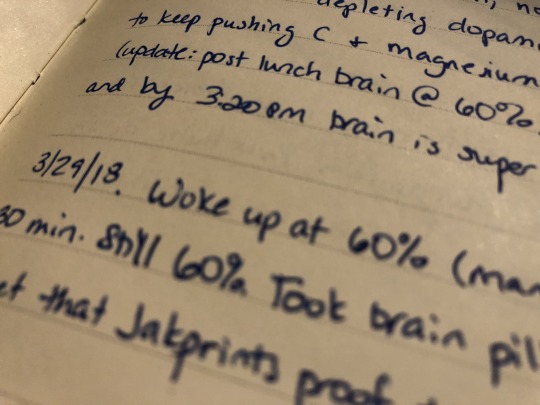
Back in early spring of this year, after I’d gotten the hookworms out of my face but while I was still dealing very intensely with all the physical damage left behind, a very wise woman gave me a piece of advice. She told me to start a journal. In the morning, she said, write down the percentage that I felt I was that day. 20% Maggie. 90% Maggie. Then I should write down what I accomplished that day.
I thought at this point she was going to tell me to admire how much I’d gotten done each day despite being ill. I didn’t want that; I didn’t need a pep talk. I needed my brain.
But that wasn’t what she said. She told me: write down what you’ve managed to do on a 20% day, what you’ve managed to do on a 40% day. Eventually you’ll have a guide so when you wake up and you’re at 20%, you won’t try to do the things you do on a 40% day. You’ll know you can just go watch a movie or sit with your goats or whatever and not feel guilty, because you were never going to write words you could keep or be able to exercise or whatever.
And that was the right way.
It meant I no longer labored for 12 hours each day, doing nothing but trying to smash my way through a draft. Instead I slowly began to write bits and bobs in on my good days. A funny thing happened then: once I was not spending every second forcing myself to do things I couldn’t, I found I had enough energy to actually start to work on myself. To look for patterns in my good and bad days. To research healthcare providers and new studies on what was wrong with me still. Slowly I found I was able to chain more of the 60% days together, then 80% days. Slowly I began to realize that although it was taking months, I was improving overall.
I threw out every labored word I had written on my current book and I began again with ferocious and structured joy. It took me only a few weeks to completely regain the wordcount of that draft I forced, only this book was free and easy and ridiculous and batshit and I loved it.
I still have 20% days. Really, seriously, don’t let hookworms in your face, especially if you already have an underlying condition. I don’t know when I’ll actually be completely better. But I do know that on those 20% days, I don’t have to make things. It’s ok. I can spend those days enjoying whatever I can. Consuming art instead of making it. That’s enough. That’s right.
I’m very proud of Saints, both how it turned out and what it took from me. But I wouldn’t wish that on anyone. There’s a better way.
“Empathy isn’t just remembering to say that must really be hard—it’s figuring out how to bring difficulty into the light so it can be seen at all. Empathy isn’t just listening, it’s asking the questions whose answers need to be listened to. Empathy requires inquiry as much as imagination. Empathy requires knowing you know nothing. Empathy means acknowledging a horizon of context that extends perpetually beyond what you can see.”
— The Empathy Exams: Essays by Leslie Jamison (via briqou)